The Queen of May

I’ve been thinking lately that I might need some Hawthorn in my life.  You’ve probably seen Hawthorn trees, they’re planted in most of the parks in New York City.  They tend to be short and wide with winding branches; perfect climbing trees if it wasn’t for the thorns on the trunk and branches. (Haw is another name for berry and then there’s the thorns.)  On some species they look really lethal.  In fact, hawthorn is quite gentle.  The berries and flowers are cardiac tonics, strengthening the heart and evening its beat.  Whether you need to be stimulated or relaxed hawthorn is on the job.  It dilates arteries and veins releasing constrictions and blockages.  It lowers blood pressure and aids in maintaing healthy cholesterol levels.  Hawthorn can be used both as a preventative tonic to keep the heart in good health and as a treatment for heart problems including angina, coronary artery disease, and loss of function due to old age.  I believe hawthorn is also a remedy for the more intangible ills of the heart, for those times when we feel “heart sick”, “heart broken”, or just a bit melancholy.  If we are having trouble expressing our emotions hawthorn can help us to open our hearts and be healed.

Hawthorns bloom in May with white, pink, or red flowers.  The tree was called the Queen of May, the May Tree, or the Faerie Tree and the blossoms were used in Beltane and May Day celebrations.  Hawthorn was treated with respect as it was a faerie tree and stood on the threshold of the Otherworld.

I heartily recommend going and sitting with a hawthorn tree.  There’s a great guide to trees in NYC put out by the City of New York Parks and Recreation department.  It’s called “New York City Trees: A Field Guide for the Metropolitan Area”.  It has information on identifying trees as well as a guide to the best place to see each tree. Or you can look it up on the internet and get a sense of what you are looking for. Don’t worry about identifying the individual species, it’s pretty difficult even for professional botanists. The hawthorn trees have apparently cross pollinated with abandon and a complete disregard for the botanical classification system. (Another reason to like them).  You can look for the thorns and the blossoms (they’re still in bud this week but will bloom soon).  When you find one, take a good look at it, really see it.  Touch the bark and smell the blooms – they have a musky scent, not what you’d expect from a flower.  Then have a seat and lean back against the trunk of the tree, feel it against your back, and just sit for a while.  It is in silence and communion that we can get to know the plants and trees that share our world, that make our lives possible.

Leave a comment

Filed under Herbs

Tender Violets

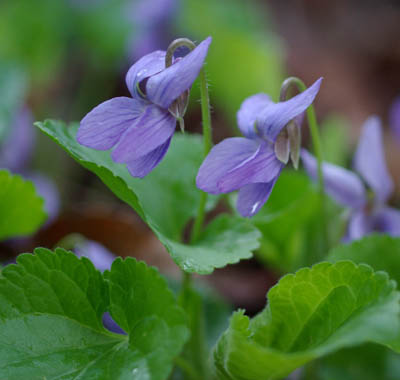
Violets.  What does that word conjure up?  Violet candies, old fashioned perfume or the actual flowers, pretty and delicate with downy heart shaped leaves.  But violets are much more than that.  For centuries they have been good medicine. Ancient Athenians used them to “moderate anger, procure sleep and strengthen the heart”.  The Britons used them as a cosmetic and the Celts recommended steeping the flowers in goat’s milk to increase a woman’s beauty.  Nicholas Culpepper, a 17th century herbalist, recommends violets for hangovers as well as diseases of the lungs and as a poultice for swelling and pain.  Modern herbalists use the leaves and flowers for upper respiratory problems, urinary infections, and skin eruptions as well as part of a long term approach to rheumatism and as a component of cancer treatment.

I used to love candied violets.  They seemed like jewels or maybe faerie food.  I had no idea there was such power in the tiny plant.  It’s this hidden power that is one of the most intriguing parts of the study of herbalism.  One can imagine roots being medicinal, they’re strong, tough and durable.  But flowers seem so ethereal, just a bit of beauty that is here and then gone in a short time.  But many blooms are mighty, filled with healing power.  Violets are coming up now in the spring.  Their flowers will be gone by mid May.  If you see one, inhale the fragrance and let some of the healing power in.

Violet Syrup

Gather 1 cup of unsprayed violet blossoms, rinse them and place into a 1 pint mason jar.  Pour in 1 cup boiling water.
Cover and let steep for 24 hours.  Strain out the blossoms, pressing on them to get all the liquid you can.
Place the violet liquid into a saucepan and add 1 to 1.5 cups of sugar (depending on how sweet you want it).
Bring mixture to a boil.  Boil on medium heat for about 5 minutes.  Pour into a mason jar or bottle.  Allow to cool completely,
cap, and store in the refrigerator.  You can add the syrup to soda water or use it in a cocktail or just have it by the spoonful.

Leave a comment

Filed under Herbs

Changeable Spring

Yesterday the sky was mostly clear and blue and I sat outside letting the sun bathe my face.  Today the sky is leaden and for a brief moment I considered building an ark.  The combination of snow on the ground, rain, and 50 degree temperatures has created a low hanging fog that’s sitting over the park.  I saw only one other person during my walk.  Amazingly, he was in just a sweatshirt. No rain jacket, no umbrella.  Just seeing him made me colder.  It can’t be that he was unprepared, it’s been raining for hours.  It always amazes me when people are so oblivious to cold.

But despite the cold there is a kind of beauty to days like this.  The fog that conjures up sprites, jacky twoad, and the Hound of the Baskervilles is delightfully otherworldly.  Rivers appear all over, the rain and snow melt running in torrents down to the river and the sky is deep,gray, and mysterious.

I went out, not just to walk in the mist, but to buy some ginger.  My circulation is a little slow, my joints crackly.  I need to warm myself up and ginger is just the thing.  I like to make fresh ginger tea.  I just grate some ginger, pour in boiling water and let sit for 10 minutes or so.  I like it just like that, bracing and pungent but I also like to add some honey and occasionally some lemon juice.  If you are feeling chilled you can also add the infusion to a hot bath.  Stay in for at least 15 minutes then wrap up well.

Leave a comment

Filed under General, Herbs

Renewal

Spring is here.  I know, we usually think of spring arriving on the equinox, March 21.  But as far as nature is concerned spring has already begun.  The days are noticeably longer than they were on the winter solstice, the sun warmer and higher in the sky.  Seeds are beginning to stir in the warmer ground, starting to push their green shoots up through the soil.  This renewal is gradual, so subtle that we may not notice it unless we really pay attention.   So it should be with us.  Spring is a great time to make changes in our own lives but we should do it gently, giving our bodies time to adjust.

We may be tempted to toss our winter gear into storage but we want to make sure we stay warm during this time.  Cut back on fatty foods, caffeine, and sugar but do so gradually, not cold turkey.  We can begin to up the pace of our exercise; spring is a great time to begin a new exercise regimen.  Exercise gets our blood and our lymph moving to increase our energy and clear stagnation.  The herbs that arrive early in the spring are perfect to help us in this work.

Dandelion is one of my favorite plants.  Its yellow flowers always cheer me up and I can make wish before blowing the seeds into the wind.  The flowers are a favorite of bees while the leaves get eaten by a variety of wildlife. Dandelions are so hearty, not to say stubborn, surviving in all kinds of places: parks, lawns, construction sites, and drainage ditches.  The long taproot pulls nutrients from deep in the ground later to be released into the topsoil.   The roots also create drainage channels in compacted soil, aerate and attract earthworms.

Dandelion clears and replenishes the soil and it can do the same for us.  The leaves are used as a diuretic, removing retained fluids and encouraging elimination and optimal kidney function without depleting the body. The roots are a real friend to the liver and gall bladder clearing stagnation, stimulating bile flow, and providing nourishment. Our liver performs more than 400 functions and can use all the help it can get.  Both the leaves and the roots serve as bitters, stimulating our digestive juices.

Dandelion leaves can be eaten as salad or steamed or sautéed like other greens and the root can be had as an extract or an infusion, warm with a little honey.  The flowers can be turned into dandelion wine and the unopened buds into a pickle.  Many people consider dandelions a scourge to be eliminated but in fact they are friends and allies.  The next time you see a dandelion smile, and thank the plant for its work and for providing us with excellent medicine.


Leave a comment

Filed under General, Herbs